
Clarksville City Directory Holdings
Clarksville city directory research begins with regional shelves. The Indiana State Library and Jeffersonville Township Public Library lists do not establish a dedicated Clarksville household volume for every year. Instead, Clarksville names can appear in Jeffersonville, New Albany, countywide, and multi-county titles. The table keeps that scope visible.
| Collection | Years | Where held | Access |
|---|---|---|---|
| Regional Williams, Bailey, Caron, and Polk titles | 1860–61; 1863–64; 1868; Caron 1882–1998 runs; Polk 2001 and 2012 | Indiana State Library and JTPL finding aids | Print, microform, scans, and library databases; Clarksville may be embedded |
| Jeffersonville city directories | 1845–46 through 2017 sequences, with gaps | JTPL Indiana Room | Microfiche, print, and licensed online routes |
| Caron regional sample | 1909–1910 | Internet Archive | Public scan and OCR; inspect the page image |
| Sanborn map companions | 1886, 1898, 1904, 1911, 1925 | JTPL and Library of Congress | Microfilm or public scans; Clarksville is a secondary location |
| Clarksville Historical Collection | Organized in 2021; mixed dates | Indiana Memory and JTPL | Free item-level browse and search |
There is no confirmed complete Clarksville reverse or criss-cross run. Nor did the research establish one final printed year for a Clarksville-only series. Record gaps and regional scope are part of the answer, not flaws to hide.
Clarksville Names in Regional Directories
The State Library's Clark County directory list starts the broad search. It identifies Jeffersonville and Charlestown for 1860–61, Williams for 1863–64, Bailey for 1868, a long Caron sequence from the 1880s into the 1990s, Polk countywide in 2001, and a Clark, Floyd, and Harrison title in 2012. JTPL's denser Jeffersonville list has sequences from 1845–46 through 2017, with gaps.
Those labels are a warning. A book with Jeffersonville on the cover can contain a Clarksville office, business, or nearby entry. Yet the full book is not thereby a Clarksville household roll. Search the place name inside the volume, inspect the page heading, and cite the actual geographic scope. This method finds relevant city directory entries without inflating what the book proves.
Note: Save the title page and locality heading with each entry so later readers can judge the book's true scope.
A Clarksville Directory Hidden in Caron
The 1909–1910 Caron regional scan holds a compact “GOVERNMENT OF CLARKSVILLE” block inside a Jeffersonville-centered volume. It names clerk Harry Stites, marshal Wm. Hillyard, treasurer Claude Mayfield, trustees, and school-board members. This is a strong dated civic roster. It is not the same as an alphabetical list of all Clarksville households, and the OCR spelling must be checked against the page image.
Search the exact heading in the Caron scan. The OCR text can lead to the right page, but it can split names and lose context. Save the publisher, year, page number, body heading, and image. Then use newspapers, census pages, deeds, or another city directory to test any claim about a person's address or identity.
This local quirk explains why title-only searches miss Clarksville. It also explains why a regional result must not be stretched beyond its text.
Read Clarksville Directory Entries
A sample inventory should record only what is visible. The captured Clarksville civic block shows names, roles, and public bodies, but no home address, spouse, owner mark, or widow notation. Household entries elsewhere may use more fields. Never add them from memory.
| Publisher and year | Identifies the edition and the date of the snapshot. |
|---|---|
| Page heading | Shows whether the entry sits under Clarksville, Jeffersonville, county, street, business, or civic material. |
| Name | Preserve initials, suffixes, spelling, and the printed order. |
| Role or occupation | Copy the wording and abbreviation as printed before interpreting it. |
| Address and household notation | Record only when shown, including spouse, boarder, widow, or owner marks. |
| Scan and page number | Lets another researcher reopen the page rather than trust OCR alone. |
- Criss-cross directory
- A later directory section arranged by street or phone rather than surname.
- Householder index
- An address-led list of the person identified as the principal householder at a dated point.
- Abbreviation key
- The publisher's explanation of marks and shortened words. Photograph it before decoding an entry.
Clarksville City Directory Research Room
The JTPL Indiana Room is the main local shelf. It holds city directories, newspapers, courthouse microfilm, maps, census material, deed indexes, vital and cemetery files, yearbooks, coroner reports, and an obituary index. The main library is at 211 E Court Avenue in Jeffersonville. The Clarksville branch at 1312 Eastern Boulevard offers a closer local contact, but much specialized material is at the main Indiana Room.
Call the Indiana Room at 812-285-5641 or write dstepro@jefflibrary.org. The brochure posts copies at $0.10 per page and says microfilm-reader time may be limited if someone waits. Ancestry Library Edition is in-library only. HeritageQuest, NewspaperArchive, and ProQuest have home-access routes subject to subscription terms. A good request supplies the person, place, record type, date range, and desired copy, then asks if a scan exists and whether staff research has a cost.
The Indiana Room holdings page is captured below as the local-history access point.
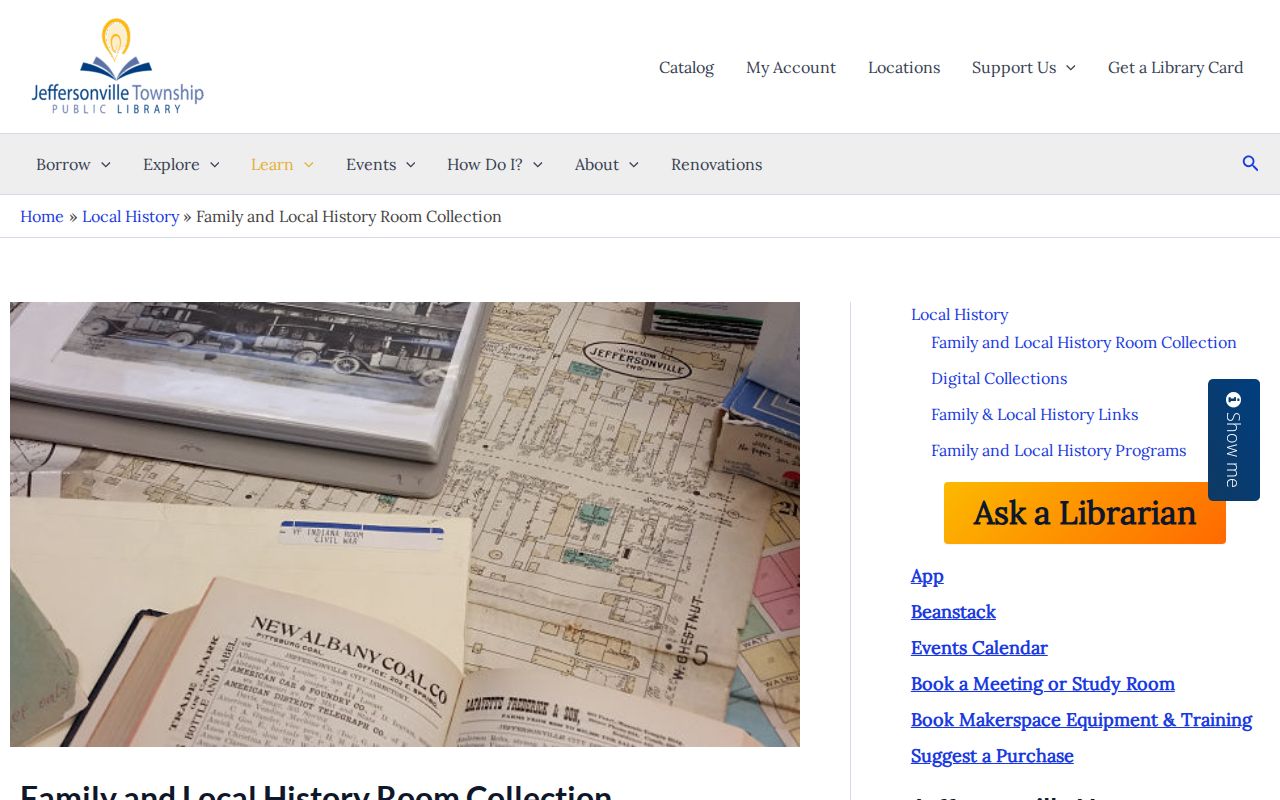
The page connects a directory name to the microfilm, map, newspaper, and index sources needed to verify it.
Clarksville Directories Meet Indiana Memory
The Clarksville Historical Collection adds maps, ownership maps, photographs, ephemera, and community items to a city directory search. JTPL says librarian Bob Glass organized the collection in 2021 from material assembled by Jane Sarles, Jeanne Burke, and the Clarksville Historical Society. Save the collection and item identifier because result links and metadata can change.
Indiana Memory is not a continuous directory run. It is a discovery layer. One early landowner and resident item covers 1784–1812, while other records document places, people, and civic life on different dates. Use item metadata to form a query, then seek the underlying deed, directory page, newspaper, map, or county record.
The collection search shown here preserves the Clarksville-specific digital route.
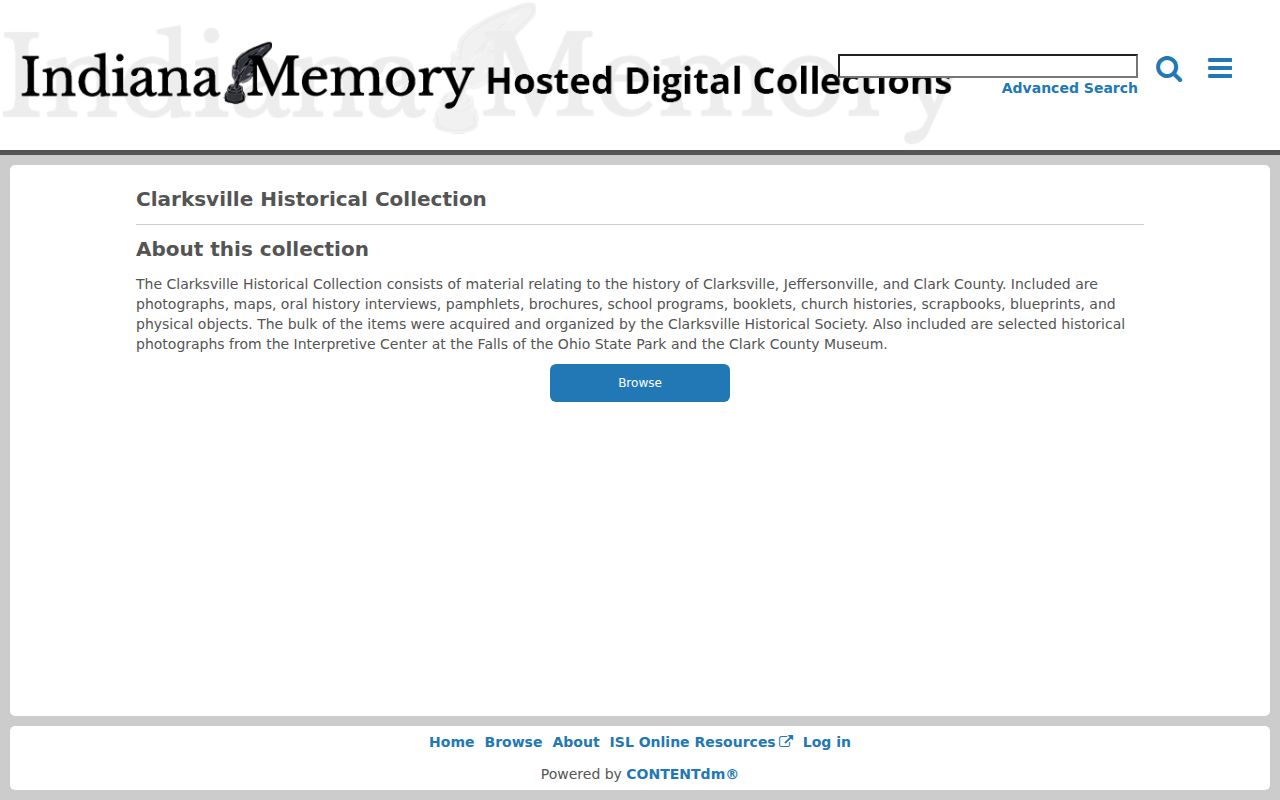
Its maps and images can explain the place around a directory entry, while the cited item remains a dated source.
Clarksville Directory Record Timeline
The city directory shelf sits inside a longer Clarksville record history. The dates below explain why some names are found at the county seat, why regional titles matter, and why a missing town record may need a newspaper or library substitute.
The Clark County Clerk of the Courts page shows the county-level route for court, marriage, election, and permanent historical records tied to Clarksville names.
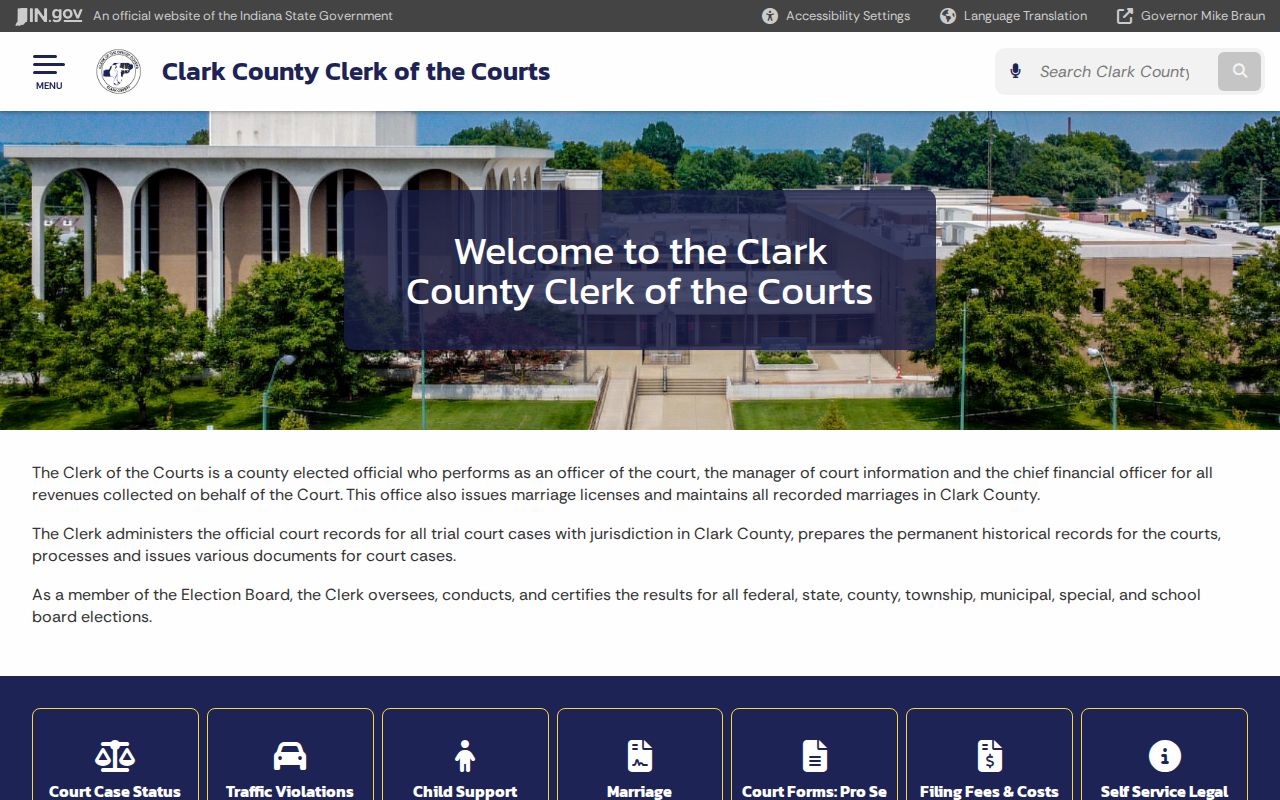
This county-seat source belongs beside the directory timeline because Clarksville records often survive under a Jeffersonville custodian rather than a town shelf.
| 1801 | Clark County was created, and Jeffersonville became the county seat for records covering Clarksville. |
|---|---|
| 1860s | Regional Jeffersonville, Charlestown, Williams, and Bailey directory titles begin the located sequence. |
| 1909–1910 | The Caron volume includes the Clarksville government roster inside a regional title. |
| 1937 | Town history says flood damage caused the loss of board-change records. |
| 1990s–2017 | Caron and later regional or Jeffersonville sequences continue, but gaps and geographic limits remain. |
| 2021 | The Clarksville Historical Collection becomes an organized Indiana Memory discovery layer. |
No single final Clarksville printed-directory year was established. A timeline should therefore cite each title and year rather than invent a clean end date. Dated civic rosters can also bridge a directory gap when their scope is kept clear.
The Clarksville boards and commissions page supplies current public-body names and meeting leads that can be saved as dated civic evidence.
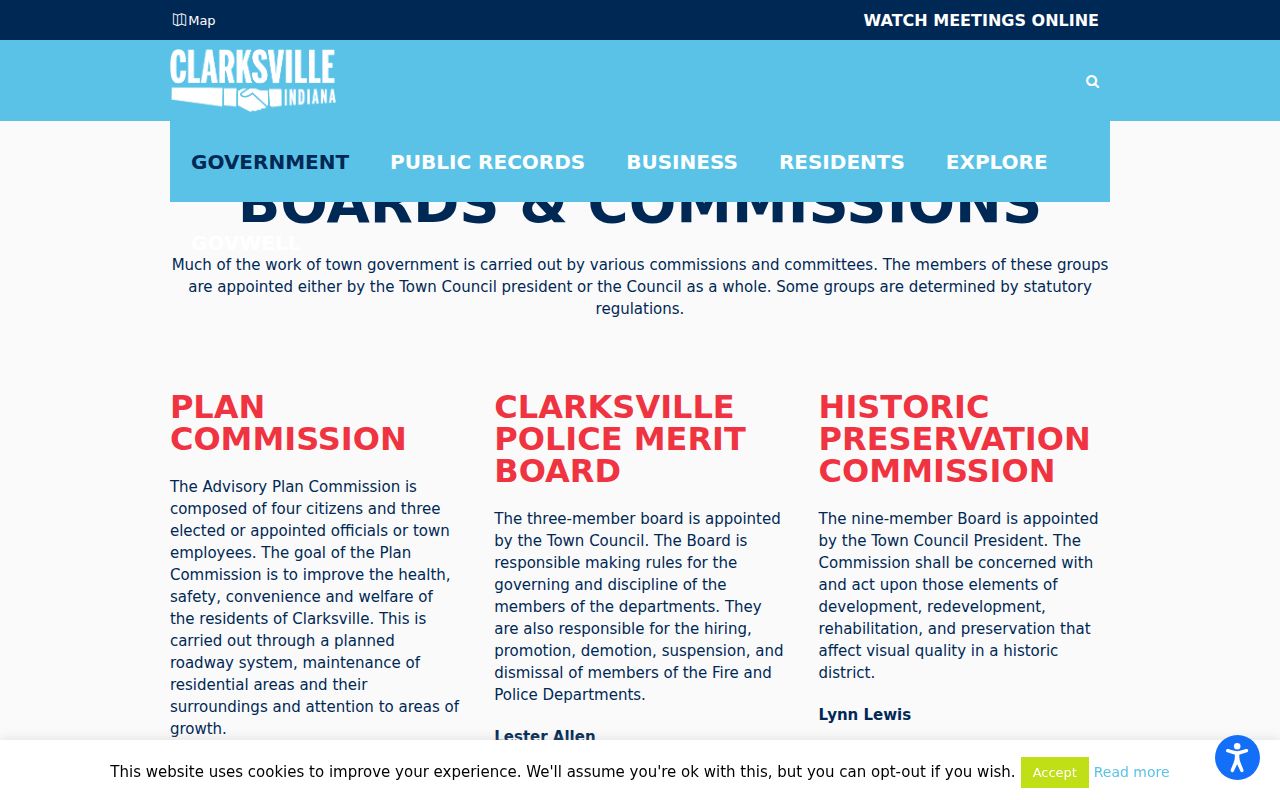
The roster can document a public role on the date viewed, but it should not be read as a household list or proof of a home address.
The 1937 Clarksville Record Gap
Clarksville town history says the 1937 flood caused the loss of board-change records. That loss is a local records story with a practical lesson. Missing municipal minutes do not show that an appointment, resignation, or public act never occurred. JTPL's flood collection, newspaper microfilm, county filings, later town histories, and regional city directories can rebuild parts of the timeline.
The town history page anchors the record-loss statement. Cite later evidence as a reconstruction and label the gap. The town page shown below is a source for Clarksville's own account, not a replacement for the lost books.
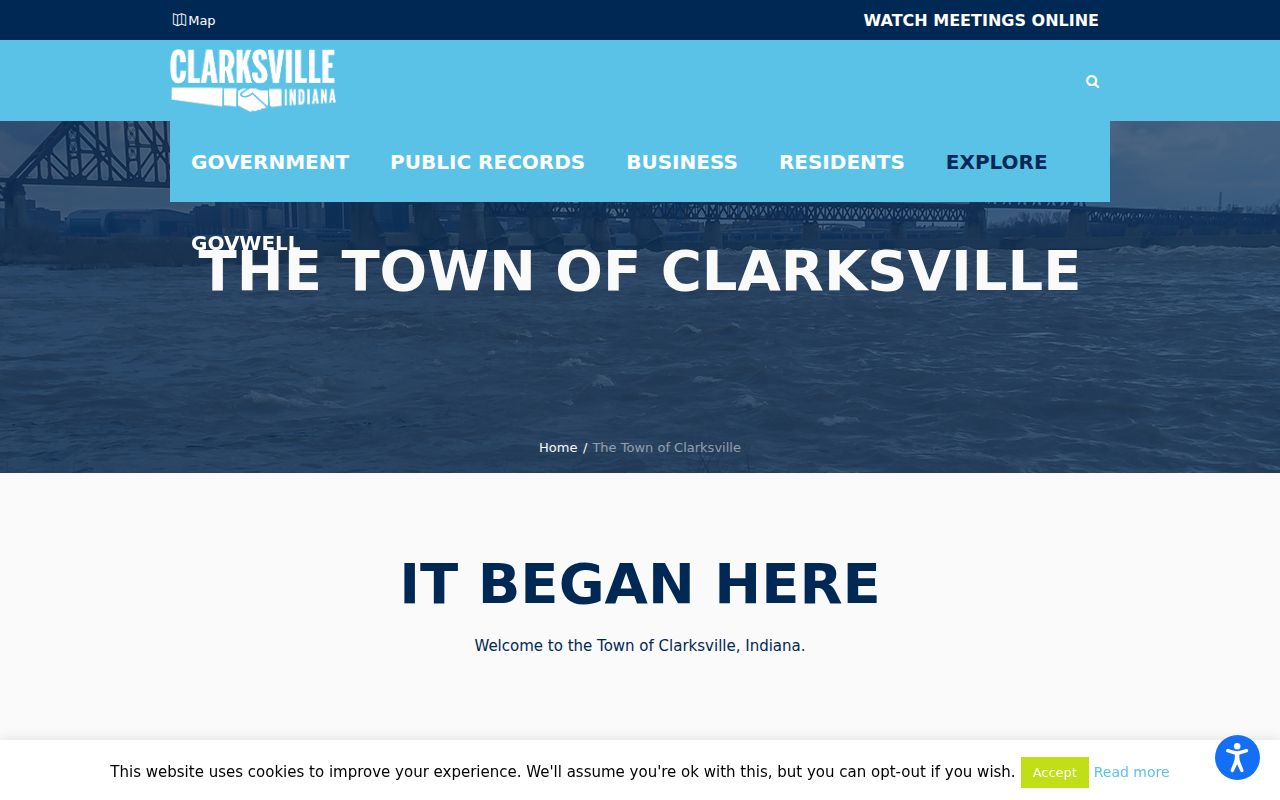
Pairing that account with dated library sources can produce a careful sequence while keeping uncertainty clear.
Companions to Clarksville City Directories
A directory gap calls for a different dated source, not guesswork. JTPL lists federal census holdings for 1820–1880 and 1900–1930, plus the 1807 Indiana Territorial Census. Newspaper microfilm includes the Evening News from November 1872 with gaps, National Democrat from 1872 to 1916, Jeffersonville Star from 1914 to 1921, and Reflector from 1903 to 1915.
Other useful layers include Clarksville town deaths from 1907–1939, Clark County marriage microfilm from 1808–1901, obituary files, cemetery indexes, coroner reports, deeds, wills, probate, Sanborn maps, yearbooks, military files, and naturalization records. The public federal census follows a 72-year release rule, so a modern person will not appear in an open current census schedule. No consolidated Clarksville church register or school alumni directory was found.
The Clark County Museum adds family papers, photographs, and early maps. Posted hours are Tuesday through Saturday, 10:00 to 4:00, with a suggested $5 admission. Contact first because it is a repository lead, not a guaranteed online name index.
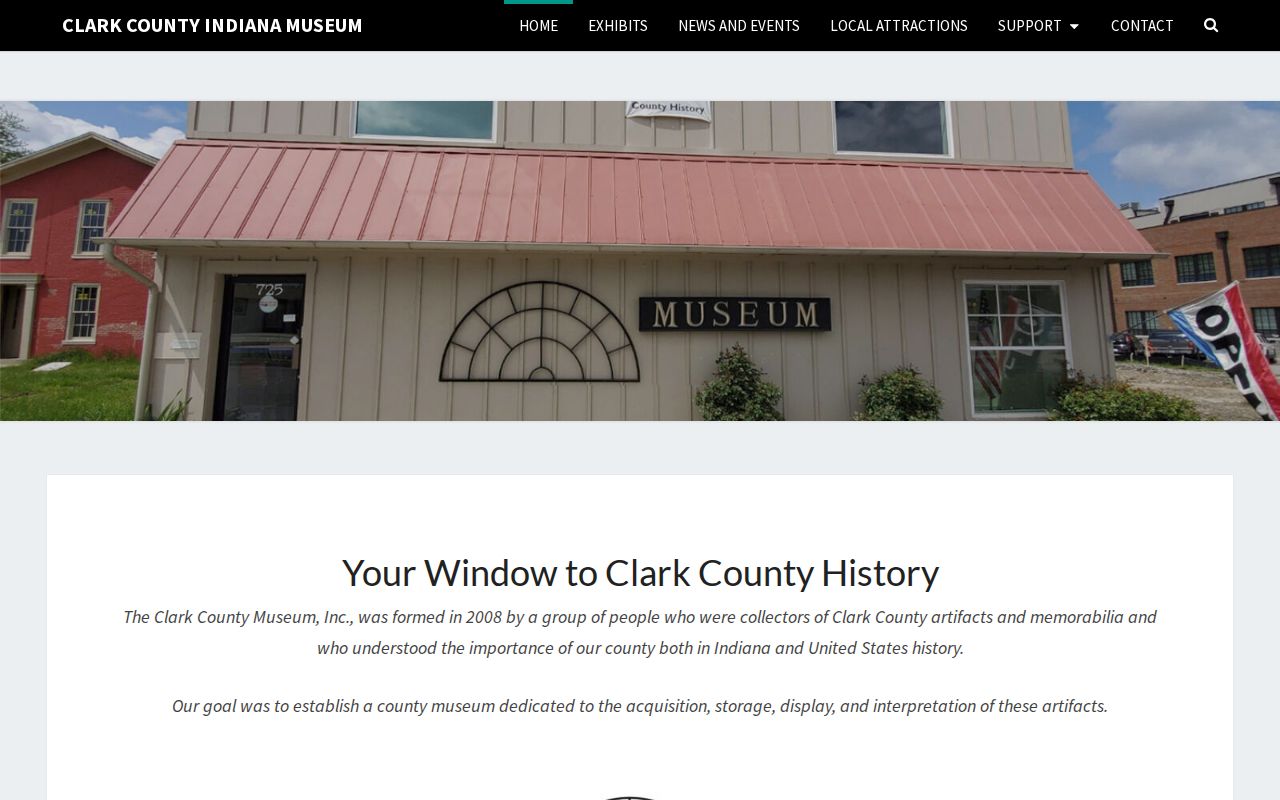
The museum view identifies a further Clarksville research contact when a directory name needs context from family papers, photographs, or early maps.
Trace Family Through Clarksville Directories
A Clarksville city directory entry earns weight when it can be repeated or checked. Begin with the closest known year and search spelling variants, initials, suffixes, Clarksville, Jeffersonville, Clark County, and the regional book title. Then move both forward and backward. Note each change in street, role, household wording, or locality heading.
- Save the title page, publisher, year, page, heading, and exact entry. Do not rely on OCR alone.
- Search the same name in the prior and next available volume. Record gaps instead of filling them.
- Compare the address with a dated Sanborn sheet, plat, deed, or census page. Keep old and modern forms separate.
- Pair directory years around open census years to identify household changes between enumerations.
- Use JTPL newspapers, obituaries, cemetery files, probate, and vital indexes to explain a disappearance or move.
A name that vanishes may reflect death, relocation, omission, a new spelling, or a volume that no longer covers Clarksville. It does not settle the question by itself. For current address-keyed property evidence, switch to the Clarksville street directory; the historical shelf should remain a dated family-history tool.